Stop using the card before you try recovery:

  1. 1️⃣ Stop using the card the moment you notice the format.
  2. 2️⃣ Scan it with recovery software before new data lands.
  3. 3️⃣ Save the recovered files to a different drive.
SoftOrbits Flash Drive Recovery Capture d
️ Eugene - rédacteur en chef de SoftOrbits, candidat en sciences informatiques, CTO de SoftOrbits
📅 Dernière mise à jour:  2026-10-13

You can recover formatted SD card files on Windows until new data overwrites them. SoftOrbits Flash Drive Recovery scans for the remaining files; the free tools below can help too.

What you'll need
  • SoftOrbits Flash Drive Recovery: scans the card and restores files locally on your PC
  • A Windows PC (10 or 11)
  • An SD card reader (a camera cable alone is not enough)
  • About 20 minutes, plus scan time for large cards

Ce que vous apprendrez

Appliquer dans
20 min Enregistrements 4 hEasy

Can you recover a formatted SD card?

TL;DR

Usually yes. A quick format deletes the file index and leaves your photos and videos on the card until new files overwrite them. Taking more photos after the format is the bigger risk.

Most people who accidentally format a card get their files back because the format rarely scrubs the chips clean. You could format a full card from a two-week trip and see it reported as empty while every frame remains on it. Recovery software rebuilds the file map or reads the raw data directly.

Your odds drop if new photos, a system thumbnail, or a fresh format pass overwrite the old files. A full format or secure erase also reduces your chances. You cannot know the outcome up front, but most files come back after a quick format if you stop using the card.

What actually happens when you format an SD card?

TL;DR

Formatting rewrites the card's file-system table, the map that points to each file. Your photo data stays in place while the card reports the space as free. A full format or physical overwrite destroys the data.

An SD card stores files on flash memory. Its FAT32 or exFAT file system keeps a table recording where each file begins and ends. A quick format replaces that table, making the card look empty in seconds.

Quick format vs full format:

SanDisk says a quick format "deletes files from the volume" without scanning the disk, while a full format scans for bad sectors. The SanDisk support page explains the difference. On modern Windows, a full format can also write zeros across the whole card. A quick format is recoverable; a full zero-fill usually is not.

4 GB
is the largest single file a FAT32 SD card can hold, so long 4K clips are often split into parts and only look "missing"
Source

Cards up to 32GB usually ship as FAT32. Larger cards default to exFAT, which removes that 4GB single-file ceiling.

Camera menus usually run a quick format, even when the screen says "Format card."

What to do first (and what not to do)

TL;DR

Stop writing to the card immediately. Pull it from the camera, do not shoot another frame, and do not let any app "repair" or reformat it. Every new file can overwrite a photo you want back.

The first five minutes:

Remove the card and set its physical write-protect lock switch to the locked position to prevent accidental writes. Connect it to a computer through a card reader. Decline any auto-fix prompt, install recovery software, and scan.

Even a thumbnail or system file can overwrite your photos. Once a flash cell is overwritten, its old value is gone. There is no second copy.

Guessing with CMD and reformats
Repeating chkdsk commands or reformatting to "fix" the card will not restore the files. Each attempt can overwrite more data.
VS
A guided deep scan
Select the card, run a signature-level scan, preview the results, and save the files you want to another drive.

Recover the card with recovery software

Download and install SoftOrbits Flash Drive Recovery

Get the free trial for Windows and install it, then connect the SD card with a card reader.

Windows 11 / 10Essai gratuit, sans inscription

 SoftOrbits Flash Drive Recovery install screen..

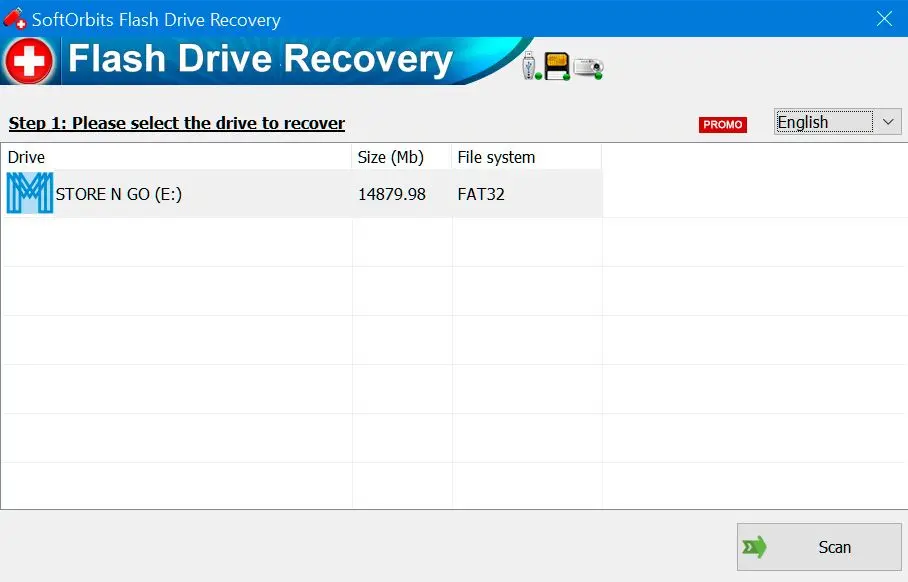
Select the SD card and choose a deep scan

Pick the card's drive letter and start a full deep scan. It reads file signatures beyond the old index.

 Selecting the SD card in Flash Drive Recovery..

Preview the found files

Wait for the scan to finish. Preview the recoverable photos and videos to confirm they open cleanly.

 Preview of recovered photos..

Save recovered files to a different drive

Select what you need and save it to your PC or another drive, never back to the same SD card.

 Saving recovered files to a PC folder..

SoftOrbits Flash Drive Recovery SoftOrbits Flash Drive Recovery

SoftOrbits Flash Drive Recovery récupère des données sur clés USB, cartes mémoire, disques externes et autres supports amovibles. Fichiers supprimés ou système de fichiers endommagé : l'outil tente de reconstruire l'arborescence et de restaurer ce qui reste accessible.

Can Windows recover a formatted SD card on its own?

TL;DR

Windows can restore a File History or OneDrive backup, or scan with the free Windows File Recovery tool. Neither reverses the format. Windows File Recovery only finds files on an SD card in its Extensive (signature) mode.

Check your backups before installing anything. Restoring photos from File History or OneDrive is faster and cleaner than a recovery scan, but only covers files you already copied off the card.

Windows File Recovery (winfr):

You can get Microsoft's free Windows File Recovery from the Microsoft Store. Its command syntax is awkward. The official Microsoft documentation specifies Extensive mode for non-NTFS file systems. SD cards are almost always FAT32 or exFAT, so "Regular" mode finds little to nothing. Choose Extensive (signature) mode, or use a graphical program that runs the same scan without commands.

Does CHKDSK or a Command Prompt trick recover it?

TL;DR

No. CHKDSK, ATTRIB, and "chkdsk /f" fix file-system errors; they cannot rebuild formatted files. Letting CHKDSK write to a damaged card can lower your recovery odds.

MiniTool's guide confirms that these commands cannot help recover data from a formatted SD card. On a RAW or damaged card, CHKDSK may appear to repair the volume while overwriting data a recovery scan could still read.

Recover your files before you let anything repair the card. CHKDSK and ATTRIB can write changes to a formatted or RAW volume.

SoftOrbits Flash Drive Recovery SoftOrbits Flash Drive Recovery

SoftOrbits Flash Drive Recovery récupère des données sur clés USB, cartes mémoire, disques externes et autres supports amovibles. Fichiers supprimés ou système de fichiers endommagé : l'outil tente de reconstruire l'arborescence et de restaurer ce qui reste accessible.

Free vs paid: is free SD card recovery good enough?

TL;DR

PhotoRec and Windows File Recovery can recover a formatted card for free, though both use a command line and lack an easy preview. Paid programs like SoftOrbits Flash Drive Recovery offer previews, simpler steps, and support.

With free sd card recovery software, you reach the same underlying data. Paying gets you an easier workflow and help when a scan stalls. PhotoRec is the standout free option. Its documentation says it "ignores the file system and goes after the underlying data," so it works on reformatted or badly damaged file systems.

480+ file types
is what PhotoRec can recognize by signature (about 300 file families), including on a reformatted card
Source

The PhotoRec project page lists the supported formats.

ToolInterfacePreview before savingSignature-based scanCost
PhotoRecCommand lineNoYes (about 300 file families)Free
Windows File Recovery (winfr)Command lineNoYes, Extensive mode onlyFree
SoftOrbits Flash Drive RecoveryGraphicalYesYesFree trial; paid license

Where free tools stop:

Free tools leave you responsible for choosing the correct output drive. For a one-time rescue of important files, clicking through a preview and saving can be easier than learning scan flags.

How to recover photos, RAW, and video files

TL;DR

Signature scans recover JPG photos, RAW files (.ARW, .CR2, .NEF), and MP4 videos the same way, provided nothing has overwritten them. Large 4K clips are the most fragile because they take up the most space.

Signature-based recovery recognizes each format's header pattern and reassembles its data, including Canon .CR2, Nikon .NEF, and Sony .ARW files. A long video spans many sectors. If any part was overwritten, you may recover a file that will not play cleanly. The same approach powers flash drive recovery for USB sticks and thumb drives.

What if the card is corrupted or shows as RAW?

TL;DR

A card that shows as RAW or asks to be formatted has lost its file-system map; its files may remain. Run a signature or deep scan first. If a program already failed, image the card to a file and recover from the copy.

Decline the Windows prompt "You need to format the disk before you can use it." When a card will not mount, dedicated data recovery software for corrupted sd card media reads it block by block and rebuilds files from signatures. This also applies to RAW external drives and external ssd recovery.

If recovery has already failed, make a single-file image and scan that copy to leave the original untouched. For a SanDisk device that will not appear, the guide to repair a SanDisk flash drive covers recognition problems. In one SanDisk community thread, changing the reader made an unrecognized card visible to recovery software.

General USB flash drive repair tools also cover sticks that will not show up, regardless of brand.


How to recover a formatted SD card on a Mac

TL;DR

On macOS, stop using the card, connect it through a reader, and run a Mac-native recovery program. SoftOrbits Flash Drive Recovery is Windows-only. You can use a macOS recovery program or borrow a Windows PC and card reader.

Open Disk Utility only to check that the card appears. Do not click Erase. Signature scanning applies on a Mac too.

How to prevent SD card data loss next time

TL;DR

Copy files off after every shoot. Eject the card safely, and confirm the files are backed up somewhere else before you format it.

Copy each shoot to two places before reusing the card. Eject through Windows to avoid pulling it mid-write. Keep a spare card so you do not have to reformat a full one during a session. The Kingston recovery tool guide covers Kingston cards and sticks. When you reuse a card, format it in the camera so its file system matches the device.

Pitfalls when recover formatted sd card

TL;DR

Most failed recoveries follow new photos, a second reformat, or saving recovered files back to the same card. These actions usually cause more damage than the original format. Avoid them to improve your chances.

✔️ Kept shooting on the card.

Reddit's r/datarecovery has accidental-format threads where photos taken after the mistake overwrote the files people wanted back.

✔️ Reformatted a second time to fix an error.

Another format or full format compounds the loss. One user wrote about 100GB of new data across two sessions and mostly recovered the wrong files. Image or scan before formatting.

✔️ Assumed the format was quick and kept using the card.

The top reply in a widely upvoted r/videography thread stresses stopping all use until recovery is done.

✔️ Saved recovered files back to the same card.

Recovered output can overwrite files the scan has yet to read.

✔️ Plugged the camera in by USB instead of pulling the card.

Over USB or MTP, many cameras hide the raw volume, so recovery software sees less than half of it. A card reader exposes the blocks a signature scan needs.

SoftOrbits Flash Drive Recovery SoftOrbits Flash Drive Recovery
Formatted the wrong SD card? A quick format only hides your files. Here is how to recover a formatted SD card on Windows before your data is overwritten.
SoftOrbits Flash Drive Recovery Capture d


🙋Foire Aux Questions

Recover your photos and videos to another drive and confirm they open before formatting. "Formatting it back" would overwrite files you want to save. After recovery, reformat the empty card in your camera or in Windows for reuse.

Not reliably. Phone apps can scan a microSD in some cases, but a desktop scan through a reader sees far more of the card. If you only have a phone, stop using the card until you can use a PC and micro sd card recovery software. The microSD card recovery software guide covers the card-reader route.

A quick format, the default in cameras and Windows, clears the file index. The data remains until new files overwrite it. A full format or secure erase can wipe the data permanently, though these are less common. Before selling or returning a card, use a program built to permanently delete files; a quick format leaves data recoverable.

Yes. PhotoRec and Windows File Recovery can recover files for free, but neither offers an easy preview. Paid programs charge for previews and an easier workflow. Free and paid programs reach the same data on the card.

Often yes. A RAW or corrupted card has usually lost its file-system map while retaining its files. After a failed attempt, image the card to a file and run a deep signature scan on that copy to avoid further attempts on the original.

Sometimes. A factory reset often triggers a quick format, leaving data recoverable. Your odds fall sharply if the reset performed a deeper low-level wipe or wrote a fresh image over the card. Stop using it and scan as you would after a format.

Sources